

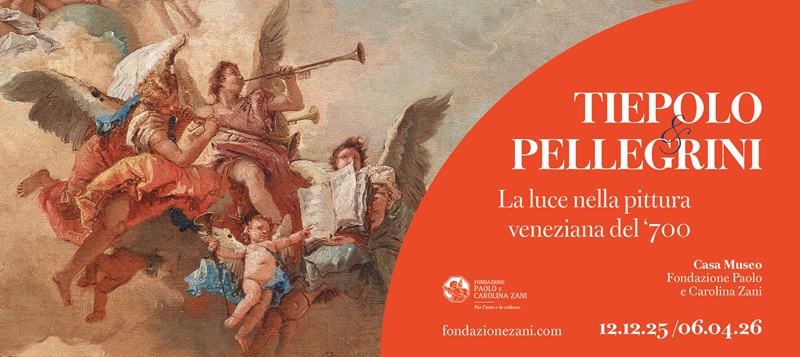
December 12, 2025 – April 6, 2026
Tiepolo and Pellegrini
Light in 18th-Century Venetian Painting
Casa Museo Zani celebrates two of the most important Venetian painters of the eighteenth century, whose distinctive trait was light, enabling their genius to resonate throughout the Baroque courts of Europe.
From their works for the churches and palaces of Venice, the two painters became true protagonists of the art scene in Germany, England, Austria, France, and Spain, with works that, through myth, celebrated princes and sovereigns.
Giovanni Antonio Pellegrini (Venice 1675-1741) and Giovanni Battista Tiepolo (Venice 1696- Madrid 1770) are the protagonists of a dossier exhibition featuring three large canvases on display at the Zani House Museum: the two oval paintings by Giovanni Antonio Pellegrini around 1724, depicting Elijah and the Angel and David Receiving the Loaves from Achimelech, from the Chapel of the Blessed Sacrament in the church of Sant’Agata in Brescia, and The Last Judgement by Giambattista Tiepolo, a work painted in the 1740s, from the Intesa Sanpaolo collection.
Presented for the first time after their restoration funded by the Paolo and Carolina Zani Foundation, Pellegrini’s ovals can now be admired on display in the fullness of their compositional and, above all, chromatic power. The two works powerfully showcase the nature of Pellegrini’s painting, which originated between the Venice of Sebastiano Ricci and the Rome of Baciccia and Luca Giordano. His style is characterized by light brushstrokes, vibrant with luminous and often impalpable effects, which had a decisive influence on the style of his sister-in-law, the painter Rosalba Carriera, and on many English and French painters of the eighteenth century. Brought to Brescia in the 1720s to adorn the church of Sant’Agata, Pellegrini’s two works remain the master’s only confirmed commission in Italy. They stand in stark contrast to the altarpiece in the Chapel of the Blessed Sacrament, where they are still preserved today. This altarpiece, executed by the Veronese artist Antonio Balestra, is marked by a severe classicism, here completely disregarded by the dazzling colors and light, which only recent restoration has fully restored.
Both paintings had their chromatic appearance altered by the presence of old Dammar varnishes, now yellowed, and significant deposits of impurities that made the subjects unclear.
The extraordinary maintenance work, carried out by the Casella studio in Brescia, aimed primarily at restoring the brilliance of the 18th-century colors. This involved a thorough cleaning of the painted surface and the application of canvas grafts to fill some gaps, which were then promptly filled. The two canvases were then subjected to the “texturizing tempera” process, necessary to recreate the texture of the painted surface. This allowed for the important chromatic integration, carried out while respecting the originality of the works themselves. The themes of the two ovals are drawn from the Old Testament and prefigure the Christological Eucharistic sacrifice: Elijah is fed in the desert by the angel who brings him a loaf of bread, while the other oval, sometimes mistakenly interpreted as the meeting between Abraham and the priest Melchizedek, depicts King David receiving two consecrated loaves of bread from Ahimelech.
The last great representative of monumental decoration in Europe, Giambattista Tiepolo is the other major protagonist of the dossier exhibition held at the Casa Museo Zani. In addition to an extraordinary collection of Baroque and Rococo sculptures, furnishings, and applied art, it boasts a veritable collection of 18th-century Venetian painting, including two paintings by Tiepolo and twenty-one other works by Canaletto, Marieschi, Bellotto, Guardi, and Longhi.
The canvas of The Last Judgement from the Intesa Sanpaolo collection, now on display in the dossier exhibition, along with the one depicting Bacchus and Ariadne from the Zani Collection, contributes to celebrating the painter’s creative journey. These are two extraordinary examples of preparatory sketches on canvas, conceived for two fresco cycles now lost or never realized. These small and large canvases were painted by the painter to imagine the grand ceilings he would later fresco in the palaces of Venice, Milan, Würzburg, and, finally, Madrid.
Tiepolo is certainly one of the most beloved painters of his time, celebrated during his lifetime and later recognized as an artist of the highest caliber even by modern critics, beginning with the writings of Bernard Berenson (1894), who, in stark contrast to Roberto Longhi, recognized in him a strength unmatched by any other Venetian painter of his day: “His energy, his taste for splendor, his mastery of the craft, place him almost on the level of the great Venetians of the sixteenth century… Sometimes he seems like the last of the great old masters, sometimes the first of the new.”
The energy and power of the vast compositions that Tiepolo knew how to create on a grand scale can be found intact in the preparatory sketches for these great cycles, as documented in the exhibition, starting with the work depicting The Last Judgement, now in the Intesa Sanpaolo collection, which can be traced back to a project for the decoration of a ceiling that was destroyed or, in all likelihood, never completed. Chronologically attributable to the mid-fourteenth century (around 1747), the canvas was published for the first time as a sketch by Giambattista Tiepolo in 1933 by Ettore Modigliani who indicated its presence in the collection of Alessandro Poss of Intra.
In this mature work, compared to Zani’s, one perceives Tiepolo’s even greater ability to theatrically arrange the scene, with a swirling rendering of the sky and clouds that seem to engulf the host of angels, divided into different categories: the musician angels, accompanied by the trumpets of judgment, and those bearing the symbols of the Passion: the cross, the ladder, the nails, the crown of thorns, and the rod with the vinegar sponge. In identifying the two distinct spheres, divine and human, light plays an important role, which is reflected in the choice of bright, pale tones for the upper part of the sky, darker tones tending toward black in the lower margin, where demons and serpents are depicted amid the flames of hell. Here, a man is dragged by his hair by a strange creature seen from behind, while a woman is torn apart by tears; alongside, skeletons and bones rise from tombs that recall the Day of the Last Judgment, a reminder of the hope of eternal life.
For the temporary exhibition, Tiepolo’s two works from the Zani Collection are presented outside the Temporary Exhibition Hall, in the Salone dell’Ottagono. The first, depicting Bacchus and Ariadne, is set in a stunning 18th-century Venetian frame and celebrates the myth of Bacchus, who, on the occasion of her wedding, gave Ariadne a golden crown, which he then threw into the sky and transformed into the constellation Corona Borealis. Bacchus thus made Ariadne immortal, as Ovid narrates in his Metamorphoses and Ars Amatoria.
Given its bold perspective and rapid execution, this canvas has long been considered a preparatory sketch for an unidentified or never-realized ceiling fresco. Attributed to Tiepolo by Eduard Sack (1910) and then by Antonio Morassi (1962), Anna Pallucchini (1968) and Filippo Pedrocco (1993, 2002) who included it among the artist’s still relatively youthful works, the work can be placed at the beginning of the third decade of the 18th century, after the completion of the frescoes in Palazzo Archinto in Milan (1730-1731) and in Palazzo Casati, then Dugnani (1731).
In the same Salone dell’Ottagono, the canvas Portrait of an Old Man (1743-45) is re-exhibited. It belongs to the famous “Philosophers” series painted by Giambattista and his sons, also documented by the series of 60 etchings by his son Giandomenico Tiepolo (1727-1804), who began producing an initial group of twenty-seven “Heads” between 1757 and 1762. Subsequently, after his father’s death (1770) upon his return from Spain, Giandomenico returned to the theme of oriental faces and expanded his collection, which totaled sixty etchings. Having passed into various collections, first in Paris with R. Kann, then in South America, then with Wildenstein, the Portrait of an Old Man from the Zani collection was studied with great attention by Antonio Morassi (1962) who underlined its neo-Rembrandtian character, more brilliant than profound, as well as considering it the same model used by Giambattista for the figure of the old man painted next to Antony in the Banquet of Antony and Cleopatra today in the National Gallery of Victoria in Melbourne (1743-1744, oil on canvas, cm. 249 x 346, inv. 103-4).