

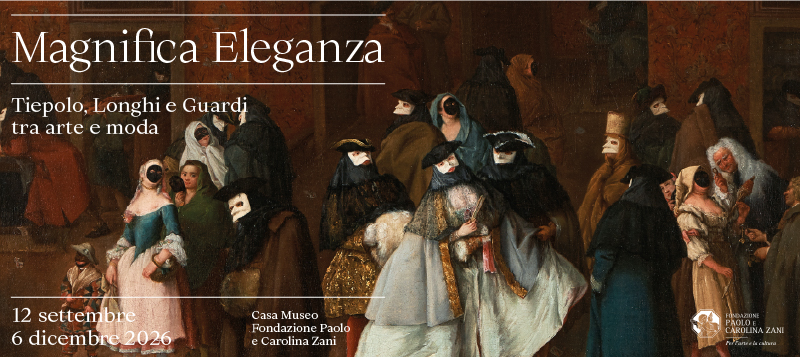
September 12 – December 6, 2026
Magnificent Elegance.
Tiepolo, Longhi, and Guardi: Where Art Meets Fashion
While the Serenissima was experiencing a slow decline in its political power, Venice conquered Europe with another form of supremacy: that of elegance.
This is the face of 18th-century Venice that the Paolo and Carolina Zani Foundation portrays in the exhibition Magnificent Elegance: Tiepolo, Longhi, and Guardi—Where Art Meets Fashion , open from September 12 to December 6, 2026, in the new Exhibition Hall of the Cellatica House Museum (BS).
Conceived and curated by Massimiliano Capella, the exhibition offers a fresh perspective on 18th-century Venetian painting through the relationship between art and fashion. The exhibition features thirty-six works, including drawings and paintings by Pietro Longhi, Giambattista Tiepolo, Francesco Guardi, and Pietro Antonio Rotari, original 18th-century garments on public display for the first time, and costumes designed by Danilo Donati for Federico Fellini’s *Il Casanova* (1976), which won an Oscar in 1977.
The works on display come from the Fondazione Musei Civici di Venezia, the Print and Drawing Collection, Ca’ Rezzonico, the Intesa Sanpaolo Gallerie d’Italia Collection – Vicenza, from the private collection of Mara Bertoli, from the Sartoria Farani archive, from private collections, and from the Paolo and Carolina Zani Foundation’s House Museum itself.
The exhibition highlights how the great masters of Venetian painting were not only interpreters of life in the Serenissima, but also extraordinary observers of social customs. In their paintings, every detail captures the tastes and social conventions of the era with surprising precision, transforming the works into authentic documents of fashion history.
Among the masterpieces on display, Pietro Longhi’s *Il Ridotto in Venezia* stands out as one of the most famous depictions of 18th-century Venetian society. More than just a genre scene, the painting reads like a veritable catalog of the Serenissima’s elegance: ladies in andrienne gowns supported by panniers, gentlemen in exquisite velade, tricorn hats, masks, silks, and brocades all evoke the atmosphere of the Ridotti—symbols of Venetian high society—where gambling, Carnival, and self-presentation became an integral part of social life. Alongside the paintings, the original garments allow visitors to verify firsthand what the artists depicted on canvas. The ample volume of the paniers, the opulence of the damasks and velvets, the lightness of the silks, the complexity of the tailored cuts, and the refinement of the embroidery are all tangibly reflected in the historical examples on display, offering visitors a direct comparison between artistic representation and the material reality of the garment.
The dialogue between artworks and costumes continues throughout the exhibition. The elegant andrienne, a central figure in Pietro Longhi’s drawings, is reflected in the original 18th-century dresses; the robe à la polonaise is recognizable in the figures that populate Francesco Guardi’s famous View of Villa Loredan in Paese, one of the masterpieces of the Paolo and Carolina Zani Foundation, presented for the occasion in a new light. The refined robe à la française, with its characteristic Watteau pleats, and the elegant habit à la française, appear in the drawings of Guardi and Giambattista Tiepolo, revealing the extraordinary prevalence of French fashion in Venice at the time. Even the accessories tell the story of a society that turned appearance into a true cultural language. Pietro Antonio Rotari’s previously unseen *Lady with a Moretta* captures the enigmatic charm of the Most Serene Republic’s most iconic female mask, while the *bautta* and *larva* populate Longhi’s scenes, evoking that theatrical and ambiguous universe that made the Venetian Carnival one of Europe’s great legends. The exquisite drawings from the Fondazione Musei Civici di Venezia, the Gabinetto Stampe e Disegni, and Ca’ Rezzonico constitute one of the exhibition’s most original sections.
More than mere preparatory studies, they appear as authentic “costume sketches” ahead of their time: sheets on which Longhi, Tiepolo, and Guardi observe garments, drapery, accessories, and poses with almost sartorial precision, offering today a unique testimony to the sartorial culture of the 18th century.
The exhibition concludes with seven costumes designed by Danilo Donati for Federico Fellini’s *Il Casanova*, on loan from Sartoria Farani. From red velvet tailcoats to large paniers, from iridescent silks to exaggerated silhouettes, the Oscar-winning costume designer’s creations do not represent a philological reconstruction of 18th-century attire, but rather a free, poetic interpretation of his imagination. The dialogue with the works of Longhi, Guardi, and Tiepolo demonstrates how the myth of 18th-century Venice continues to inspire cinema, fashion, and contemporary visual culture to this day.
With “Magnifica Eleganza,” the Paolo and Carolina Zani Foundation continues its original programming for the Exhibition Hall with an exhibition that weaves together art history, the history of costume, and material culture, inviting the public to view Venetian painting from a fresh perspective.
Conceived and curated by Massimiliano Capella, the exhibition offers a fresh perspective on 18th-century Venetian painting through the relationship between art and fashion. The exhibition features thirty-six works, including drawings and paintings by Pietro Longhi, Giambattista Tiepolo, Francesco Guardi, and Pietro Antonio Rotari, original 18th-century garments on public display for the first time, and costumes designed by Danilo Donati for Federico Fellini’s *Il Casanova* (1976), which won an Oscar in 1977.
The works on display come from the Fondazione Musei Civici di Venezia, the Print and Drawing Collection, Ca’ Rezzonico, the Intesa Sanpaolo Gallerie d’Italia Collection – Vicenza, from the private collection of Mara Bertoli, from the Sartoria Farani archive, from private collections, and from the Paolo and Carolina Zani Foundation’s House Museum itself.
The exhibition highlights how the great masters of Venetian painting were not only interpreters of life in the Serenissima, but also extraordinary observers of social customs. In their paintings, every detail captures the tastes and social conventions of the era with surprising precision, transforming the works into authentic documents of fashion history.
Among the masterpieces on display, Pietro Longhi’s *Il Ridotto in Venezia* stands out as one of the most famous depictions of 18th-century Venetian society. More than just a genre scene, the painting reads like a veritable catalog of the Serenissima’s elegance: ladies in andrienne gowns supported by panniers, gentlemen in exquisite velade, tricorn hats, masks, silks, and brocades all evoke the atmosphere of the Ridotti—symbols of Venetian high society—where gambling, Carnival, and self-presentation became an integral part of social life. Alongside the paintings, the original garments allow visitors to verify firsthand what the artists depicted on canvas. The ample volume of the paniers, the opulence of the damasks and velvets, the lightness of the silks, the complexity of the tailored cuts, and the refinement of the embroidery are all tangibly reflected in the historical examples on display, offering visitors a direct comparison between artistic representation and the material reality of the garment.
The dialogue between artworks and costumes continues throughout the exhibition. The elegant andrienne, a central figure in Pietro Longhi’s drawings, is reflected in the original 18th-century dresses; the robe à la polonaise is recognizable in the figures that populate Francesco Guardi’s famous View of Villa Loredan in Paese, one of the masterpieces of the Paolo and Carolina Zani Foundation, presented for the occasion in a new light. The refined robe à la française, with its characteristic Watteau pleats, and the elegant habit à la française, appear in the drawings of Guardi and Giambattista Tiepolo, revealing the extraordinary prevalence of French fashion in Venice at the time. Even the accessories tell the story of a society that turned appearance into a true cultural language. Pietro Antonio Rotari’s previously unseen *Lady with a Moretta* captures the enigmatic charm of the Most Serene Republic’s most iconic female mask, while the *bautta* and *larva* populate Longhi’s scenes, evoking that theatrical and ambiguous universe that made the Venetian Carnival one of Europe’s great legends. The exquisite drawings from the Fondazione Musei Civici di Venezia, the Gabinetto Stampe e Disegni, and Ca’ Rezzonico constitute one of the exhibition’s most original sections.
More than mere preparatory studies, they appear as authentic “costume sketches” ahead of their time: sheets on which Longhi, Tiepolo, and Guardi observe garments, drapery, accessories, and poses with almost sartorial precision, offering today a unique testimony to the sartorial culture of the 18th century.
The exhibition concludes with seven costumes designed by Danilo Donati for Federico Fellini’s *Il Casanova*, on loan from Sartoria Farani. From red velvet tailcoats to large paniers, from iridescent silks to exaggerated silhouettes, the Oscar-winning costume designer’s creations do not represent a philological reconstruction of 18th-century attire, but rather a free, poetic interpretation of his imagination. The dialogue with the works of Longhi, Guardi, and Tiepolo demonstrates how the myth of 18th-century Venice continues to inspire cinema, fashion, and contemporary visual culture to this day.
With “Magnifica Eleganza,” the Paolo and Carolina Zani Foundation continues its original programming for the Exhibition Hall with an exhibition that weaves together art history, the history of costume, and material culture, inviting the public to view Venetian painting from a fresh perspective.
For information and reservations: 0302520479 – info@fondazionezani.com